Showing posts with label Keegan McCauley. Show all posts

Sunday, April 10, 2011

A day at the Clinic


Questioning one's existence can come in, what I feel to be, a variety of forms. Take for example this patient. He claims that he can "remember" the sixties, what he is unsure of is whether or not he was really there. Remembering something of your past is a very individual recollection because you do not have anything to compare it to and you can never actually know if you were actually there.

Sure you might say that you could compare it to other person's experiences of the sixties but you still don't know if you were actually there because all you are comparing is their understanding of what their experience actually was. How is it that someone can understand something that is external to themselves?

Sunday, April 3, 2011

Doubt

It's funny to think that if one has doubt in their religion that it affirms their faith. Normally I feel that if someone were to have doubt or uncertainty in their religious beliefs that it would call into question how faithful that person truly is. This idea of a "Leap of Faith" makes sense though. By understanding the "risks" and being uncertain you are able to take the gamble and make the leap.

Every time I hear the phrase Leap of Faith, I always think of Indiana Jones: The Last Crusade. First off, that was an excellent, excellent movie. Toward the end the scene where Indy has to go get the Cup of Christ in order to save his father and pass the three tests of the faithful man are an exact representation of this philosophy. The Breath of God test, The Word of God test, and the Leap of Faith test were all representations of this philosophy. Granted they might be a little over the top but still really cool none the less. I think that Spielberg did a great job with that movie and had some truly brilliant ideas when directing that movie.

Friday, March 25, 2011

Chickens!

So I was passing some time on stumbleupon, as every good college student should, and I came across this link: http://chickenphilosophy.pen.io/

Since the beginning of class we have learned that it was the philosophers that would ask the hard questions and it's both interesting and funny pondering their response to the age-old question, "why did the chicken cross the road?"
Reviewing Marx in class not only allows for his "response" to make sense but it makes it all the more funny. I think that in a Marxist society that the chicken just wouldn't have to worry about crossing the road because the means for him to do so would be already provided for him.

With that said Marx's faux response seems to me like he comes off as this, "it was written in the stars" sort of guy, which may not be entirely true but it does have some truth in it I feel. Sure one can certainly learn from the past to know more about the present and even into the near future, but can one use the past to define something beyond that?

Sunday, February 27, 2011

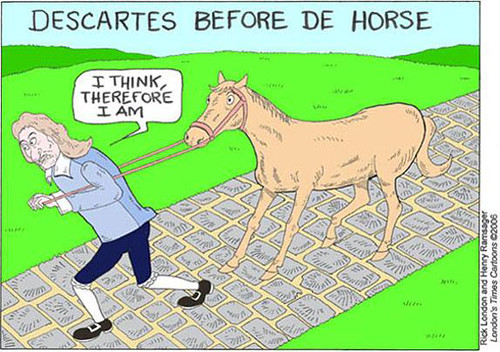
The Cart Before the Horse

Researching Descartes, I came across this lovely cartoon that was published in the London Times a few years back. With my little knowledge of the French language for quite some time that this person's name was pronounced phonetically until I heard his name pronounced "de-cart." And now that I have this knowledge, it makes this comic all the more funny.

Thinking of this now from a philosophical standpoint, having a little basis of understanding of Descartes' philosophy, this brings up some interesting points. Since Descartes is "a thinking thing" he cannot therefore be a cart which can never be a thinking thing. With that in mind, do carts exist or are they figments of our imagination? In other words, are carts things that are external to our mind or internal to our mind?


Sunday, February 20, 2011

Movie Night

So this Friday I went with some of my friends to go see Liam Neeson's new movie, Unknown, and it was really, really awesome. I recommend it to all of you out there that are considering to see it and for those of you that want to see it I suggest that you don't continue reading this post because I may ruin it for you so with that in mind:

***SPOILER ALERT***

So Liam Neeson's character is a spy/pseudo-terrorist/badass in this movie that gets into a random car accident while on a job. He flies off this bridge in Germany into the river and bangs his head on the glass window in the car as he plummets down into the river, after being rescued he wakes up in a hospital and suffers some memory loss. What he doesn't remember is that he is this international agent, what he remembers and believes are the "memories" that he and his other operatives made up for their background/cover stories. This isn't revealed to us though until the movie is within 20 min of ending, it was a way cool plot and it took a really surprising turn which was just done really well.

Then being a good philosophy student, my mind became riddled with questions that I didn't have the answers to. For instance, what is it that we know about the truths in our lives? What if we were to wake up and not have a solid memory like Liam Neeson's character in the movie? Who would I think I was? Would I think that I am someone that I'm not at all like in the movie?

Then upon returning to the dorm we watched another movie The Island made in 2005 with Ewan McGregor and Scarlett Johansson and that was also a very good movie (the above spoiler alert is still in effect). In this movie, taking place in the near future, there are clones that are made of people for medical purposes and kept in this Giant facility where they go about their lives. What's interesting is that the clones don't realize that they are clones and they think they are these actual people. One of them begins to question who he is and questioning the things around him and he figures out that his reality is not real at all and that everything around him was false.

Both of these movies made me think about what makes a person a person. Is it the memories or their ability to question some of the things around them or is it what they think they know as truths? In both films truths were proven to be false and realities were drastically changed.

Great movies, I recommend them both.

***END SPOILER ALERT***

Sunday, January 30, 2011

Atomism

As a chemist by trade one of the things that Dr. Layne had mentioned in lecture were the Atomists and that made me perk up a little bit in class .

She mentioned how they believed all things came from atoms and I think to myself, "yes! Finally away from all that water and air stuff!" Now we're on to something that I can agree to, atoms composing everything in the natural world. Now it is known that there are numerous subatomic particles that even make up atoms, but for the ancient world this is still a pretty cool notion.

When I first cam across this thought of everything being made up of atoms as a kid I then wondered, "If all things are atoms, then there are tiny tiny gaps between all the atoms. If all things have all these gaps because they are made of atoms if I were to sit in a chair over and over and over again and aligned everything just right, would all the 'atom gaps' line up and I could then pass through the chair?" Silly yes, but I still wondered and pondered until I later learned about all the electrostatic interactions that occur both intermolecularly and intramolecularly. It made sense to me and really it was this question that got me interested in the sciences.

Since atoms are made up of neutrons, electrons, protons, etc. are there neutronists and electronists much like there are atomists? Or are they encompassed by the atomists? Or are they known as today's chemists and physicists?

I may be interested in the atomists the most because I think I would like to owe it to them in a round about sort of way for my love of the sciences.

Monday, January 24, 2011

Mechanics and Art

In Friday's class the subject of art being a mechanical process was brought up and I just wanted to show this really great video that, in my eyes, blew that statement out of the water.


This man, Theo Jansen, completely wowed me once I saw this video. His knack to see something like that is incredible.

He defines himself as two things: an engineer and an artist. Two professions that one would not commonly associate with one another, but then I got to thinking; isn't an engineer just that? A fusion of both those fields? Bridges, computers, cars, heck even staplers were originally something that someone thought up and then created into a physical object.

Wait, what??

That's right, another topic riddled with philosophical concepts. The idea of a stapler that then somehow defines what everything is that encompasses the idea of stapler and then those ideas are then transformed into action and ultimately become a nifty device that enables the user to hold multiple sheets of paper together in an orderly fashion.

"The walls between art and engineering only exist in our mind." -Theo Jansen

The Art of Arguing-Class Notes 1/21

Class January 21, 2011

Arguments can come in two forms: the formal argument, and the informal or familiar argument. In Friday’s class a formal argument was under review and Aristotle’s syllogism was presented to us. Syllogism has two parts to it: premises and conclusions.

Premises are statements that one argues from, i.e. 1) All men are mortal. 2) Socrates is a man.

Conclusions are assertions that you are arguing to, Therefore, Socrates is a mortal.

The premises must be interwoven and inevitably must lead to the conclusion.

An argument is a process of reasoning that intends to establish the truth of a conclusion and is valid if the conclusion follows the premises. An argument is invalid if the conclusion does not follow the premises.

Arguments do not typically follow this formulaic premise, premise, conclusion formula in a choppy fashion. They follow the natural language and normally have a multitude of various premises to qualify the conclusion. They are more eloquent and complex and often have “conclusion indicators” that include, but are not limited to: thus, so, therefore, hint, consequently, so we see that, and we may conclude.

We then practiced viewing several “arguments” and tried to identify whether or not the statements were valid or invalid arguments (the patriotic citizen, humpty dumpty, the disgruntled art student)

There were also two types of arguments that were presented in this class, the Sophistic argument and the Socratic argument.

Sophistic arguments are what we typically see on a political platform where there are two persons each taking one pro and one contra side to a certain conclusion. One person agrees with the conclusion and the other constructs his premises to contradict the original conclusion. Sophists are often the people that play the “devil’s advocate.”

Socratic arguments often analyze the validity of the premises in order to establish the opposite conclusion.

Now that the idea of an argument is at least slightly more concrete and defined it is now that one is able to evaluate an argument and determine whether or not it is well constructed (valid or invalid). Just because the argument’s conclusion follows the premises does not necessarily make the argument true. We, the person evaluating the argument, must either accept or deny the conclusion that the person making the argument is trying to present. More often than not these conclusions are made from what are known as False Premises.

In one case all sentences within the argument may be false for example 1) All streets in New Orleans are paved with gold. 2) Wall Street is a street is a street in New Orleans. Therefore Wall Street is paved with gold.

In another type of these faux arguments the premises are false but the conclusion is true. 1) All cats are green. 2) All things that are green have paws. Therefore all cats have paws.

In lieu of this lecture it has caused me to reflect on various everyday occurrences and evaluate each situation and figure out if what had happened was in fact an argument. I live with four other guys and at least once a day we find ourselves in some sort of heated discussion/debate and I now can step back analyze what going on, pick apart the statements being made and ask myself, “is that really an argument?”

Wednesday, January 12, 2011

Color, Light and Time

Today the ideas of light, color and time were all briefly mentioned in lecture today, and I had found an article that discusses in depth what two of these are: Light and Time. From a physics standpoint the slowing down and acceleration of light to achieve "invisibility" astounds me. The fact that we have the technology, or at least the know-how, to accomplish something like this and make Harry Potter a reality is incredible; with no wand required either. After reading this it made me curious as to what I really knew about both Light and Time. The two I thought were concrete enough and now I can learn about them in a truly mind boggling way. The writer declares this as, "the most awesome and the most dangerous idea ever..." This now brought a series of new questions to my attention: how can I use this to trick my friends; when can this be perfected to bring the two people into a conversational distance versus having them a mile apart from each other; will this technology be used for less than legitimate purposes; will light-bending-time-cheating crime be a thing of the future; will this all be the plot to the next James Bond movie?

Technology I find is amazing and the advances it is making is equally a wonder. Conversely, I feel like technology is also our greatest Achilles heel of our time.